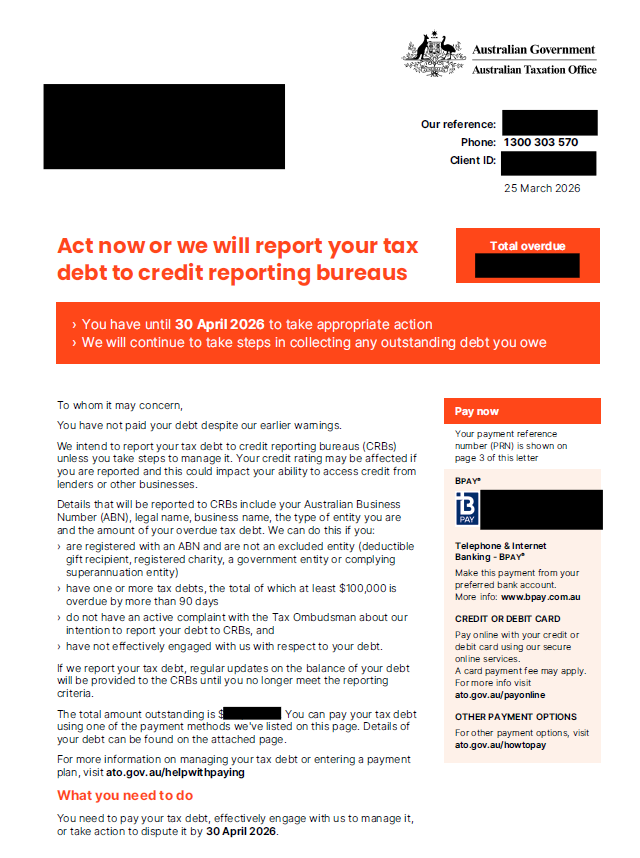
You paid the wages. You paid the suppliers. The BAS was the one thing that slipped.
That is how it usually starts. Not recklessness. Just a run of tight months where something had to give.
The problem is what happens next. The ATO can put that unpaid tax debt on your business credit file. Most owners do not hear it from the ATO. They find out when a supplier quietly moves them to cash on delivery.
Yes. Since 2018 the ATO has been able to report unpaid business tax debt to credit reporting bureaus. For years it barely used that power. Now it uses it routinely.
Your business can be reported if all four of these are true:
- you have an ABN
- you owe $100,000 or more in tax debt, added up across everything you owe
- that debt has been overdue for more than 90 days
- you are not effectively engaging with the ATO about it
That $100,000 catches more businesses than people expect. It is rarely one big bill. It is unpaid BAS, PAYG withholding and super, building quietly over a couple of years.
At 30 June 2026, more than 35,000 Australian businesses were sitting above that threshold. Just over half were sole traders.
Businesses carrying an ATO debt above $100,000 are 31 times more likely to fail than the average Australian business. In the year to June 2026, 21.9% of them became insolvent, against a national average of 0.7%.
That is not a forecast for your business. It is a warning sign, and a warning sign is only useful while you still have time to act on it.
This is the question most owners are really asking. It has two parts.
The listing goes on your business credit file, not your personal consumer credit score. Those are two separate files.
But it reaches you personally in other ways.
If you are a sole trader, there is no company standing between you and the debt. It is legally yours from day one.
If you run a company, the ATO can issue a Director Penalty Notice, a notice that makes you personally liable for unpaid PAYG withholding, GST and super. In 2024-25 the ATO issued 84,529 of them, covering $5.5 billion in debt.
Most owners have also signed personal guarantees with suppliers and equipment finance. When those accounts turn bad, the guarantee is called on you, not on the business.
So the listing sits on the business. The consequences do not stay there.
The credit file entry is not the damage. The reaction to it is.
A default stays on the commercial credit file for five years. Trade credit insurers watch those files. When a tax default appears, the insurer withdraws cover, and your supplier has little choice but to pull your terms.
One de Jonge Read® client ran a joinery and cabinet making business supplying commercial builders. They had a $600,000 tax debt and a defaulted payment plan. Rather than call the ATO, they ignored it.
Within four days of the listing, their timber, aluminium and veneer suppliers had all revoked terms. Every one of those accounts was current. None were overdue.
From that point it was cash on delivery, while the business waited 30 days after end of month to be paid by its builders. The cash flow gap did more damage than the tax debt ever had.
The listing is not automatic. The ATO sends an Intent to Disclose notice first, and that gives you 28 days to pay the debt or get a payment plan in place.
A payment plan you are meeting counts as engaging. So does an active objection or review. Silence does not.
If the debt is already listed, paying it or entering a plan means the ATO notifies the bureau and the listing comes off.
Waiting is the expensive part. Since 1 July 2025, ATO interest is no longer tax deductible, and the rate sits at 11.43%. The debt grows faster and costs you more.
Options narrow as the debt grows. Acting early keeps more of them open. There are business restructuring options available well before a debt reaches this point.
If your ATO debt is heading towards $100,000, or a notice has already landed, the safest step is to get clarity early. de Jonge Read® acts for you, not the ATO and not your creditors.
Did you know?
Phoenixing is another name of business restructure. Read more about business restructures and when this can be an option for you.