For years, superannuation, or super for short, was one of the few bills you could time. You paid it each quarter. If a month was tight, that deadline gave you a little room to breathe.
From 1 July 2026, that room is gone.
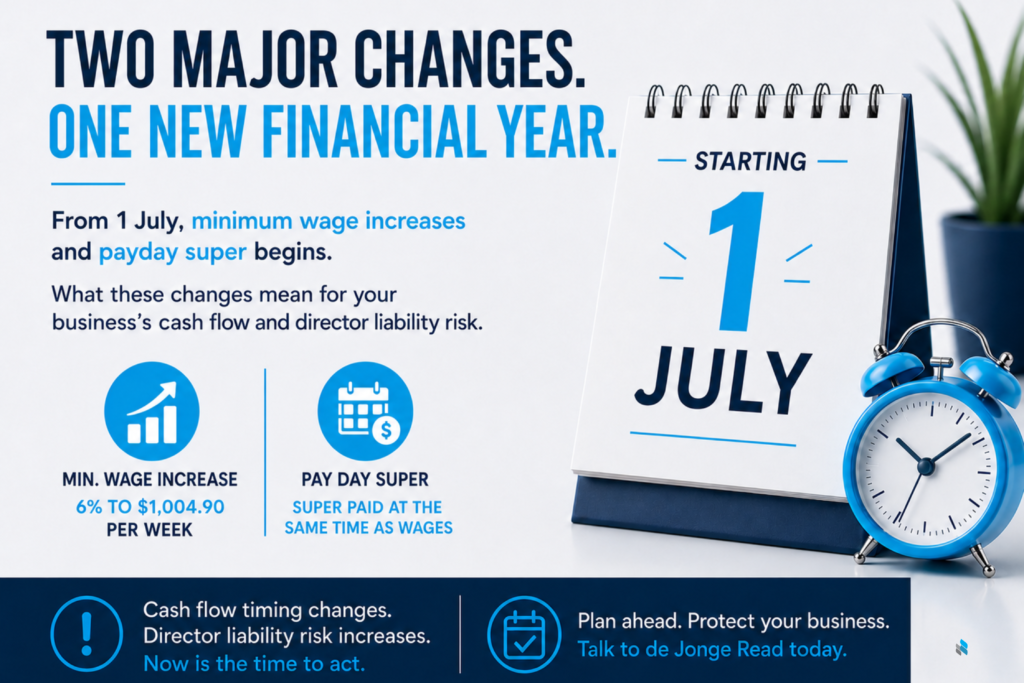
Super now has to be paid at the same time as wages, on every pay run. And in the same week, award wages and the minimum wage go up. Two costs landing together.
If money is already tight, this is not a small adjustment. It changes when cash leaves your business.
What is actually changing on 1 July?
Three things happen at once.
Payday super begins. Super has to reach your employees’ funds within seven business days of each payday, instead of once a quarter.
Wages rise. Award wages go up 4.75%, and the National Minimum Wage rises 6% to $1,004.90 a week.
The ATO’s Small Business Superannuation Clearing House is closing. If you use it to pay super, you will need another way to pay before the change.
Why does this matter if cash is already tight?
Under the old system, super could sit in your account for up to three months before it had to be paid. Many owners quietly relied on that gap to manage cash.
That gap disappears.
Picture your business with $40,000 in monthly payroll. At 12%, that is around $4,800 of super a month. Today it can stay in the business for a quarter. From 1 July, it leaves with every pay run.
If you invoice on 30- or 60-day terms, that money was working capital you were leaning on. Now it is gone the moment you pay your staff.
How can falling behind on super become my personal problem?
This is the part most owners do not see coming.
When super is not paid on time, it turns into a Superannuation Guarantee Charge, a debt owed to the ATO. Unpaid super is one of the debts the ATO can make you personally responsible for through a Director Penalty Notice (DPN), a notice that moves a company debt onto you as the director.
Under the quarterly system, a shortfall could sit unnoticed for months. Under payday super, it shows up almost straight away. The time between falling behind and that debt becoming yours is much shorter now.
How do I know if I am at risk?
It is worth looking closely if any of these sound familiar:
- You have an ATO payment arrangement that depends on paying super quarterly.
- You have super that is unpaid, or often paid late.
- You are in hospitality, construction, labour hire or healthcare, where wages are a big share of revenue.
- You often rely on the next customer payment to make payroll.
- You hold less than three months of cash.
None of these on its own means the worst is coming. Together, they are a sign to look at the numbers now, not in July.
What can I do before 1 July?
Run your numbers against your weekly or fortnightly payroll, not your quarterly figures. Seeing super leave on every pay run can change the picture quickly.
Sort out how you will pay super once the clearing house closes.
And if the cash flow looks tight, get a clear view of your options while you still have them. You can read more about how Small Business Restructuring can keep a viable business trading on our SBR page (djra.com.au/our-services/small-business-restructuring/).
When should I get help?
The earlier the better. Options narrow as debt grows. Acting before a notice arrives keeps more of them open.
You do not have to decide anything today. But understanding where you stand, early, is what protects you and your business.
A confidential, obligation-free conversation costs nothing. Getting clarity now, while options still exist, is always easier than managing a crisis once one has started. Call 1300 765 080 or visit our contact page to speak with the team.
Did you know?
Phoenixing is another name of business restructure. Read more about business restructures and when this can be an option for you.